Supplies of water, heating oil and fuel are low at evacuation centers, where many survivors wait bundled in blankets. Many elderly lack proper medical supplies. Food is often rationed. [I saw on the news what the people at one evacuation center received for lunch: a ball of rice the size of a plum and a quarter of an apple.]Nearly 320,000 households in the north were still without electricity in near-freezing weather as of Friday afternoon, Tohuku Electric Power Co said, and the government said at least 1.6 million households lacked running water.
The National Police Agency said on Friday it had confirmed 6,539 deaths from the quake and tsunami disaster, exceeding 6,434 who died after the Kobe earthquake in 1995. But 10,354 people are still missing.
Showing posts with label Japan. Show all posts
Showing posts with label Japan. Show all posts
Friday, March 18, 2011
latest stats on post-quake japan
Taken from recent Reuters article:

naked shaking
You know that thing people always say about not wanting to be caught without undies in the event of an emergency? Well, guess which idiot decided to take a long bath when earthquakes are on everyone's mind and aftershocks are still occurring daily?
I had good intentions. The living room was so cold yesterday because I've been trying my best to conserve energy, by not using the heater. Edward the Dog and I looked at each other, both of us shivering and miserable, and I decided that at least one of us should be given a short reprieve. So I ran myself a bath, got out an old paperback novel, and settled in for a nice soak. Unfortunately, just as the water was approaching that uncomfortably lukewarm point, another quake started.
I'm ashamed to admit that for longer than a moment, I hesitated. Book held aloft, I assessed the shaking--or, rather, the sloshing water--and decided that (a) it was just another mini aftershock and (b) it would be *really* cold getting out of the water. That's really wrong, isn't it? I should have leaped out and at least put some clothes on. I'm worried that I'm getting complacent.
I had good intentions. The living room was so cold yesterday because I've been trying my best to conserve energy, by not using the heater. Edward the Dog and I looked at each other, both of us shivering and miserable, and I decided that at least one of us should be given a short reprieve. So I ran myself a bath, got out an old paperback novel, and settled in for a nice soak. Unfortunately, just as the water was approaching that uncomfortably lukewarm point, another quake started.
I'm ashamed to admit that for longer than a moment, I hesitated. Book held aloft, I assessed the shaking--or, rather, the sloshing water--and decided that (a) it was just another mini aftershock and (b) it would be *really* cold getting out of the water. That's really wrong, isn't it? I should have leaped out and at least put some clothes on. I'm worried that I'm getting complacent.
Wednesday, March 16, 2011
what's left behind
Almost all the foreigners I know have fled Tokyo or even Japan--probably at the urging of concerned loved ones glued to their tellies. My mom tells me on a daily basis that she fears the situation in Japan is getting worse and sends me frequent little emails of impending doom predicted by CNN. And yet, today I woke up feeling a lot calmer [damn, I think I spoke too soon: we're having another quake...ohhh-kaaay, not as bad as yesterday night].
Yes, the mini quakes that occur daily keep us a little on the edge of our seats. Yes, I'm terrified at the thought that I'll be upstairs and R downstairs if another big earthquake strikes. Yes, we are now having to deal with four overheating nuclear reactors and I can't help thinking "Is that it?" when the big solution seems to be: So we're going to drizzle seawater over 'em.
But I've heard that meat and rice are reappearing on the supermarket shelves. Now I just have to keep my fingers crossed about diapers--Amazon Japan and Babies R Us Japan were sold out the last time I checked--though I have enough for now to last me over a week.
And I just learned that they have started testing the radiation levels in Tokyo on an hourly basis and are even publishing the results online. In this regard, the government is trying to keep on top of the situation and I feel more assured than I did yesterday.
Yes, the mini quakes that occur daily keep us a little on the edge of our seats. Yes, I'm terrified at the thought that I'll be upstairs and R downstairs if another big earthquake strikes. Yes, we are now having to deal with four overheating nuclear reactors and I can't help thinking "Is that it?" when the big solution seems to be: So we're going to drizzle seawater over 'em.
But I've heard that meat and rice are reappearing on the supermarket shelves. Now I just have to keep my fingers crossed about diapers--Amazon Japan and Babies R Us Japan were sold out the last time I checked--though I have enough for now to last me over a week.
And I just learned that they have started testing the radiation levels in Tokyo on an hourly basis and are even publishing the results online. In this regard, the government is trying to keep on top of the situation and I feel more assured than I did yesterday.
Finally got to watch some news with simultaneous English interpretation on TV and feel so ashamed of my self-absorption with the threat of radiation from the Fukushima nuclear plant. Although it seems that's the topic on almost everyone's mind, rather than the thousands of people who are currently stranded without water or heat.
It is bitterly cold tonight. Even R didn't want to go outside this afternoon, for which I was supremely grateful. But the conditions over here are nothing compared to what many people farther up north are enduring. The news reveals that those towns destroyed by earthquake and tsunami are now turning white with heavy snowfall. And many of the people over there are without adequate clothes, blankets, heat, food, you name it.
Even worse, there are people around the 30km radius from the nuclear plant who have been all but stranded and deserted. There is no gas to travel out. And truck drivers are too afraid to venture that close to the plant to bring basic supplies, even though that distance is in fact still safe.
The multiple issues over at the nuclear plant are serious, no doubt. But I fear that a lot of people are suffering because the media is focusing so much on the dramatic radiation threat and building up our anxieties to the point that we have forgotten there are people facing far more immediate, critical, and real problems.
It is bitterly cold tonight. Even R didn't want to go outside this afternoon, for which I was supremely grateful. But the conditions over here are nothing compared to what many people farther up north are enduring. The news reveals that those towns destroyed by earthquake and tsunami are now turning white with heavy snowfall. And many of the people over there are without adequate clothes, blankets, heat, food, you name it.
Even worse, there are people around the 30km radius from the nuclear plant who have been all but stranded and deserted. There is no gas to travel out. And truck drivers are too afraid to venture that close to the plant to bring basic supplies, even though that distance is in fact still safe.
The multiple issues over at the nuclear plant are serious, no doubt. But I fear that a lot of people are suffering because the media is focusing so much on the dramatic radiation threat and building up our anxieties to the point that we have forgotten there are people facing far more immediate, critical, and real problems.
Tuesday, March 15, 2011
Monday, March 14, 2011
I can't shake this constant feeling of dread and anxiety and I don't know if it's because there's a damn nuclear reactor leaking radiation a bit too close to home or because that's how I tend to feel when I'm taking Clarinase. Yeah, that's right, seasonal allergies don't get put on hold just because there are more pressing issues at hand. Apologies in advance if any of my comments seem to have come from a fuzzy brain--they have.
I keep encountering conflicting scenes that are keeping me in a state of unbalance. Yesterday, I was completely taken off guard when a visit to the nearby supermarket revealed a scene of restrained chaos. The first shock was that the shelves that normally hold diapers and toilet paper were completely emptied. And no one knew when new stock would arrive. And I only had two rolls of toilet paper left in the house. As my footsteps unconsciously sped up, I spotted more and more gaping sections of shelves where meat, rice, and bread used to be. It was hard not to panic, not to start snatching up whatever was left, not to take things I ordinarily wouldn't reach for.
Suddenly, I spotted a woman holding the Holy Grail: toilet paper! Trying not to jump on her like a rabid animal, I asked her where she had found hers and quickly followed her directions to a nearby store. I guess I wasn't totally taken aback when I saw the long line of people snaking out the door. The store worker unpacking the toilet paper told us very sweetly to each take just one pack. Despite the feeling of desperation in the air, I noticed everyone around me remained kind and helpful with each other. No rioting for the Japanese, thank god.
While we waited to pay for the precious toilet paper clutched in my arms, R glanced back and forth at all the people ahead of and behind us, and asked in amusement what everyone was doing. Thank god she managed to be distracted by a banana, since our shopping trip had taken twice as long as planned. As we emerged from one supermarket, I noticed the checkout lines had tripled in length.
Later in the afternoon, though, a stroll through a nearby park revealed couples cuddling on benches, people walking their dogs, old men drinking beer and fishing. Today, we saw a man washing his car, two ladies buying flowers, a mother pushing her son on a swing, people tending their gardens: the mundane and the frivolous, everyday life. When all the images being repeatedly displayed on the news show entire towns swallowed up by water, fires at nuclear plants, people lost and crying, it feels wrong to want to buy vanilla essence because you're running out. I look at the man sitting in the real estate office, the construction workers continuing to build that new house across from us, all those thousands of people cramming the train stations to capacity, lining up for miles and waiting for hours to get on a train to get to work: I marvel at their determination and optimism. It's tempting to want to huddle at home and listen to the dire news on the TV and radio all day long, but I think a lot of people around me are doing their best to get on with life. Having a toddler around has forced me to do the same: There are meals to cook, dirty fingers to wash, sand to shovel, naps to enforce. No time to just sit around and brood, though that doesn't mean my mind isn't racing when it's given the chance.
I keep encountering conflicting scenes that are keeping me in a state of unbalance. Yesterday, I was completely taken off guard when a visit to the nearby supermarket revealed a scene of restrained chaos. The first shock was that the shelves that normally hold diapers and toilet paper were completely emptied. And no one knew when new stock would arrive. And I only had two rolls of toilet paper left in the house. As my footsteps unconsciously sped up, I spotted more and more gaping sections of shelves where meat, rice, and bread used to be. It was hard not to panic, not to start snatching up whatever was left, not to take things I ordinarily wouldn't reach for.
Suddenly, I spotted a woman holding the Holy Grail: toilet paper! Trying not to jump on her like a rabid animal, I asked her where she had found hers and quickly followed her directions to a nearby store. I guess I wasn't totally taken aback when I saw the long line of people snaking out the door. The store worker unpacking the toilet paper told us very sweetly to each take just one pack. Despite the feeling of desperation in the air, I noticed everyone around me remained kind and helpful with each other. No rioting for the Japanese, thank god.
While we waited to pay for the precious toilet paper clutched in my arms, R glanced back and forth at all the people ahead of and behind us, and asked in amusement what everyone was doing. Thank god she managed to be distracted by a banana, since our shopping trip had taken twice as long as planned. As we emerged from one supermarket, I noticed the checkout lines had tripled in length.
Later in the afternoon, though, a stroll through a nearby park revealed couples cuddling on benches, people walking their dogs, old men drinking beer and fishing. Today, we saw a man washing his car, two ladies buying flowers, a mother pushing her son on a swing, people tending their gardens: the mundane and the frivolous, everyday life. When all the images being repeatedly displayed on the news show entire towns swallowed up by water, fires at nuclear plants, people lost and crying, it feels wrong to want to buy vanilla essence because you're running out. I look at the man sitting in the real estate office, the construction workers continuing to build that new house across from us, all those thousands of people cramming the train stations to capacity, lining up for miles and waiting for hours to get on a train to get to work: I marvel at their determination and optimism. It's tempting to want to huddle at home and listen to the dire news on the TV and radio all day long, but I think a lot of people around me are doing their best to get on with life. Having a toddler around has forced me to do the same: There are meals to cook, dirty fingers to wash, sand to shovel, naps to enforce. No time to just sit around and brood, though that doesn't mean my mind isn't racing when it's given the chance.
Sunday, March 13, 2011
Returning
I'm sorry that it took a major disaster to get me blogging again, but here I am, mostly for my own sake, to get all my fears off my chest, to calm the panic, to share what's going on here in Tokyo.
The funny thing is that A, R, and I were all out of the country when the earthquake struck. A was in the US on a business trip. R and I were overseas, visiting my parents. Unfortunately, we were all scheduled to fly back the following day. A part of me hoped Narita Airport would stay closed, forcing all of us to stay away. It didn't. So here we are, back in Japan, four days later.
We actually arrived Saturday afternoon, our two flights close enough in time for A and I to meet at Narita and attempt to return to our apartment together. As soon as I called A from my cell phone after getting off the plane, and he explained the transportation situation, that's when the doubts started coming. The trains--really, the only decent way to get to and from the airport--had all stopped after the quake and many of them were still not running. Schedules were completely thrown to the wind. The only ones functioning were the local trains, which would stop at every single station. It could take hours--hours of standing, changing trains, waiting for new ones--to get home. And we happened to have a two year old with us, one who hadn't slept a wink on the plane and was already letting me know matter-of-factly that she was well and done with all this traveling business. I've bitched and moaned about it countless times, but never had the distance from Narita to Tokyo seemed so far as it did that night.
It was getting late, R was getting ornerier, and we finally got off the train, caught a taxi to Makuhari--a neighborhood near Disneyland--and checked into a hotel. It turned out to be an interesting stay. Makuhari is one of the newer residential areas, built on a landfill--not the most stable place to be during an earthquake. Although the proof of that wasn't clear until we woke up the next morning and took a walk down the street. Many of the sidewalks had actually buckled and cracked, and huge pools of mud had seeped through the cracks to cover entire sections of walkways and roads. And we were in Tokyo, which had supposedly been spared the full force of the quake.
I also saw, in a nearby neighborhood, people lining up for water.
Luckily, the trains we needed to get home were up and running, and we made it in about two hours. Even luckier, our apartment survived the 5.0 earthquake with only a single casualty: an overturned potted plant.
Unfortunately, the situation at the nuclear plant as well as the threat of additional earthquakes still hang over our heads, making the overall atmosphere tense. Well, I for one am feeling tense. And as selfish as this sounds, a part of me regrets returning to Japan. Yes, my husband is here, my home is here, but all I can think about right now is R. All my protective mom instincts are telling me that I should never have brought her back here. She's only two and doesn't have a clue what's happening, what could still happen. If it were just me, I would have come back to Japan and A without hesitation. But now I'm scared. I wonder, if there's another big earthquake, if everything comes crashing down and the streets are impassable, how am I going to get her to safety? How am I going to keep her safe and warm and clean and dry and not hurt, not hungry, not thirsty, not terrified?
The people in Sendai and the surrounding areas are the ones suffering right now and in desperate need of aid. I know I should be getting my act together and doing all I can to help. I know that.
The funny thing is that A, R, and I were all out of the country when the earthquake struck. A was in the US on a business trip. R and I were overseas, visiting my parents. Unfortunately, we were all scheduled to fly back the following day. A part of me hoped Narita Airport would stay closed, forcing all of us to stay away. It didn't. So here we are, back in Japan, four days later.
We actually arrived Saturday afternoon, our two flights close enough in time for A and I to meet at Narita and attempt to return to our apartment together. As soon as I called A from my cell phone after getting off the plane, and he explained the transportation situation, that's when the doubts started coming. The trains--really, the only decent way to get to and from the airport--had all stopped after the quake and many of them were still not running. Schedules were completely thrown to the wind. The only ones functioning were the local trains, which would stop at every single station. It could take hours--hours of standing, changing trains, waiting for new ones--to get home. And we happened to have a two year old with us, one who hadn't slept a wink on the plane and was already letting me know matter-of-factly that she was well and done with all this traveling business. I've bitched and moaned about it countless times, but never had the distance from Narita to Tokyo seemed so far as it did that night.
It was getting late, R was getting ornerier, and we finally got off the train, caught a taxi to Makuhari--a neighborhood near Disneyland--and checked into a hotel. It turned out to be an interesting stay. Makuhari is one of the newer residential areas, built on a landfill--not the most stable place to be during an earthquake. Although the proof of that wasn't clear until we woke up the next morning and took a walk down the street. Many of the sidewalks had actually buckled and cracked, and huge pools of mud had seeped through the cracks to cover entire sections of walkways and roads. And we were in Tokyo, which had supposedly been spared the full force of the quake.
I also saw, in a nearby neighborhood, people lining up for water.
Luckily, the trains we needed to get home were up and running, and we made it in about two hours. Even luckier, our apartment survived the 5.0 earthquake with only a single casualty: an overturned potted plant.
Unfortunately, the situation at the nuclear plant as well as the threat of additional earthquakes still hang over our heads, making the overall atmosphere tense. Well, I for one am feeling tense. And as selfish as this sounds, a part of me regrets returning to Japan. Yes, my husband is here, my home is here, but all I can think about right now is R. All my protective mom instincts are telling me that I should never have brought her back here. She's only two and doesn't have a clue what's happening, what could still happen. If it were just me, I would have come back to Japan and A without hesitation. But now I'm scared. I wonder, if there's another big earthquake, if everything comes crashing down and the streets are impassable, how am I going to get her to safety? How am I going to keep her safe and warm and clean and dry and not hurt, not hungry, not thirsty, not terrified?
The people in Sendai and the surrounding areas are the ones suffering right now and in desperate need of aid. I know I should be getting my act together and doing all I can to help. I know that.
Tuesday, October 12, 2010
japanese babywearing
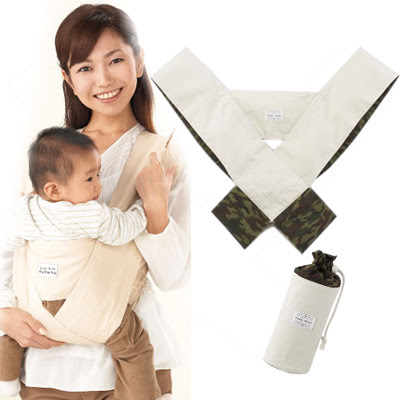
I was really lucky that I discovered babywearing while pregnant because R turned out to be the kind of baby who always wanted to be held, and at 23 months, this inclination has not changed. I was just wondering this morning as I held her throughout our morning walk whether it's possible for a toddler's muscles to atrophy from lack of use. This girl does not like to walk--or, rather, she likes being held by me more than she does walking.
I was really excited when we first moved back to Japan and I noticed what a big babywearing culture exists in Japan, or at least around where I live. It's very common to see a mom on a bike with a toddler in a child seat and a baby strapped to her front or back. And the dads don't seem shy about using wraps and slings, either.

BUT while babies are worn quite a bit, toddlers are not. In Japan, toddlers either walk or sit quietly in strollers--and, yes, they are *always* quiet. I don't know how Japanese parents achieve this. Whippings? Maybe noisy, squirmy toddlers just don't get taken out? Anyhow, the only toddler carrier I've seen around is the Ergo, which I don't like because the baby is quite low down when worn on one's back. It's also not the best carrier for a smaller person, as it's quite big and bulky.
Right now, I'm using a BabyHawk Oh Snap, which I bought used off the Babywearer.com forum. The best thing about it is the high back carry--compared to, say, the Ergo or Beco (which I had previously been using and loved, but R grew to hate once she was about 15 months old). Compared to my Beco Butterfly, though, the OS feels pretty bulky, with lots of long straps dangling all over the place. Before I had R, I wouldn't have been caught dead wearing something like this (it looks a lot *neater* in the picture to the right). The problem is that to support a bigger, heavier child, you do need something more structured, hence the name Soft Structured Carrier, which refers to carriers with the belts and buckles.
I definitely wouldn't recommend the Oh Snap for a smaller person, even though I've had petite moms tell me that it works for them. I think it's because I can't get everything tightened up as much as I need it that sometimes my shoulders start aching if I wear R for too long. I never had this problem with my Beco.
The problem is that the toddler carriers out there that I've been told work for smaller women are STUPIDLY expensive. I'm talking US$180 for a used carrier. So then I started looking at Japanese-made carriers. And found some great-looking stuff. Unfortunately, I don't know where or how to begin researching how good these carriers really are, and, more importantly, most of these carriers seem to have a maximum weight limit (for the child) of 10kg. R is just a little over that. But I'm so tempted to get the sling-type carrier pictured at the top of this post. It's just a small X-shaped cloth, and like a baby pouch, it folds up nice and small; many times, I've been caught without a carrier--but needed one desperately--and wished I had something like this, something portable enough to always have on hand. But, unlike a sling or pouch, it has two-shouldered support, so I would assume it's more comfortable.

The other carrier I would have loved is this Japanese SSC called Sun & Beach. It's made for a smaller body frame and is wonderfully compact and light (my friend has one and I've tried it on). It also comes in really cute colors and patterns. But although the kid in the picture to the left looks about the same size as R--maybe even bigger--the website says the carrier is meant for babies up to 10kg. Darn!
Thursday, October 7, 2010
 Here's a photo randomly added, mostly for color. It's the view from my kitchen and it's my favorite time of day, twilight.
Anyhow, all that aside, I'm really glad my MIL found this class for us. This is Tokyo: the baby swimming class we attempted and failed to participate in had 30 moms and babies. Can you imagine the amount of noise and splashing--not to mention peeing--going on? But Sesame Club has the rare rule of keeping class size to a maximum of five kids, and in fact, there's only R and one other little boy in ours. Thank god. So although there was a bit of clinging at first, R actually managed to relax and participate in the class. Total miracle.
I think it will also be good preparation for kindergarten--both in terms of socializing and being exposed to Japanese. I just worry though that R might be confused because she is being taught new ways of saying words she's only recently learned: dog, train, etc.
Which brings us to a concern for many foreign families living overseas: your first language being the minority language. Growing up in Canada, I knew a lot of kids whose parents spoke a different language to them, but who always answered back in English. I worry that this will happen with R. I respect that she's going to grow up and most likely live in Japan forever, but I still want her to keep her options open, and be able to communicate with people on my side of the family: her grandparents, cousins, uncles, etc.
A and I have decided to practice what is known as Minority Language at Home (although we didn't know it even had a name at the time we agreed on it). This means we'll always speak English at home, unless we have Japanese visitors over, of course. The problem is that as she grows older, the percentage of time she spends at home and hears English will get less and less. Also, since A isn't around that much, there aren't many opportunities for R to hear English being spoken interactively. But this is what we'll stick with.
Much harder is for me to speak English to R outside of the house, which is what I've decided to try to do as well. If we're in the company of people who only speak Japanese, of course we won't. But even when it's just R and I, it's so hard not to feel self-conscious. Speaking English in public in Japan will get you a reaction every time. Being a person who HATES HATES HATES being stared at, it's so tempting to switch to Japanese and just melt into the crowd. Before R came along, I even spoke to Edward the dog in Japanese, when we were out on walks. I've had people in front of me on escalators whip their whole bodies around to gape at me, when they overheard me speaking English. I almost caused an accident for a person on a bicycle once.
But one point about encouraging bilingualism in your children, I think, is to never make them feel that one language is better than the other. And never act embarrassed to speak a different language from everyone else, which is a challenge in Japan, where being different--and, worse, being blatant about it--is a bad, bad thing. So although I haven't done a good job until this point, from now onward, I am going to casually and happily speak English to R, no matter the audience or reaction, and we are going to get used to it, gosh darn it.
Sorry, this post was all over the place.
Subscribe to:
Posts (Atom)
